Israel responded with weeks of devastating airstrikes on Gaza, followed by a ground invasion that began over three weeks ago.
More than 11,000 Palestinians have been killed during the Israeli offensive, according to the Health Ministry in the Hamas-run territory. It does not differentiate between civilians and militants, though some two-thirds of the dead have been identified as women and minors. Israel says thousands of Hamas militants have been killed.
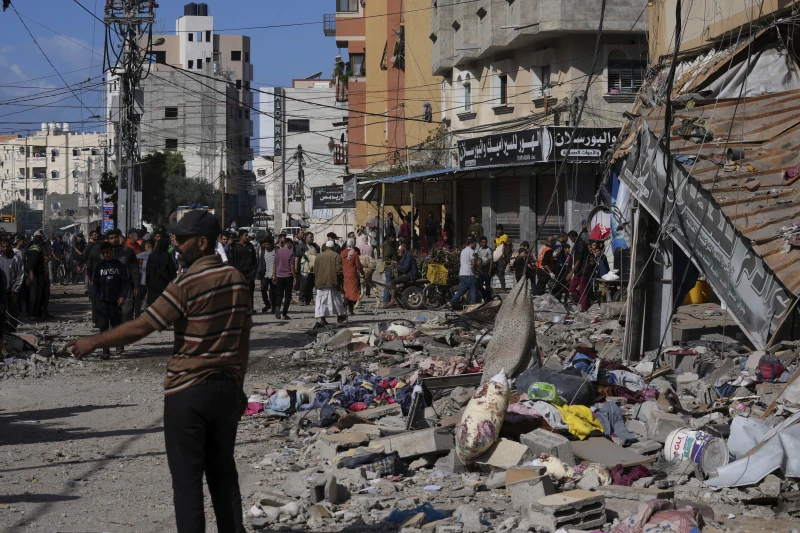
The invasion has caused vast destruction in northern Gaza, including Gaza City, displaced an estimated 1.7 million people and caused a humanitarian crisis with shortages of food, medicines, fuel and other key supplies throughout the territory.
Israel has rejected growing international criticism and vowed to press ahead until it destroys Hamas’ military and governing capabilities and all hostages are freed. Hamas, an Islamic militant group sworn to Israel’s destruction, has ruled Gaza since ousting the internationally recognized Palestinian Authority in 2007.
The return of any of the hostages could lift spirits in Israel, where the plight of the captives has gripped the country’s attention. Airwaves are filled with interviews with families of the hostages, who include babies and toddlers, women and children and people in their 80s with health issues.
The families have become a powerful force in Israel, staging mass demonstrations and marches pressuring the government to bring home their loved ones. They have made a central Tel Aviv square their headquarters, where evocative displays like a long white table with seats for all 240 hostages are meant to keep their plight in the public eye.
But the structure of the deal could weaken Israel from various directions.
Any pause would give Hamas and its shadowy leader, Yehya Sinwar, a chance to regroup after suffering heavy losses during the fighting, especially if Hamas drags things out with additional hostage releases.
Israel claims to have killed thousands of Hamas fighters, though it has not presented evidence, and destroyed parts of the group’s underground tunnel system. But Israeli officials acknowledge much of the group’s infrastructure remains intact.
A cease-fire could also add to the already growing international pressure on Israel to halt its offensive as the full extent of damage in Gaza becomes apparent. Even the U.S., Israel’s chief backer, has expressed concerns about the heavy toll on Gaza’s civilian population.
Some three-quarters of Gaza’s population has been uprooted from their homes and are staying in overcrowded and unsanitary shelters.
Many, if not most, will be unable to return home because of the vast damage in the north and the continued presence of Israeli troops there. That could lead to an even worse humanitarian disaster as people remain in shelters or are forced to live in tents through the cold, rainy winter.
And in Israel, the staggered releases of hostages risks triggering divisions between families of those who are freed and those who remain in captivity. Soldiers, for instance, are likely to be among the last to be freed. Families of the soldiers, who include young women who served as spotters along the border, are likely to press the government not to resume the offensive until their loved ones return home as well.
“There are many families and many opinions,” Hadas Kalderon, whose two young children were abducted with their father, told Israel’s Channel 12 TV.
A lengthy truce could also affect Israel’s battle readiness. While Israeli troops are expected to remain in place and the Israeli military said its battle plans remain intact, it will be difficult and risky for the army to leave its forces stationary behind enemy lines.
Asked about a cease-fire, the army’s chief spokesman, Rear Adm. Daniel Hagari, said: “The army will know how to maintain its operational achievements.”
Hamas may try to declare a victory, but Sinwar will have little to celebrate. Even if he survives and Hamas maintains power, he will emerge to vast destruction that will take years, if not decades, to repair.
In the meantime, fighting continued on Tuesday, with the front line of the war shifting to the Jabaliya refugee camp, a dense warren of concrete buildings near Gaza City that houses families displaced in the 1948 war surrounding Israel’s creation.
Israel has bombarded the area for weeks, and the military said Hamas fighters have regrouped there and in other eastern districts after being pushed out of much of Gaza City.
In southern Lebanon, an Israeli strike killed two journalists with Al-Mayadeen TV, according to the Hezbollah-allied Pan-Arab network and Lebanese officials. There was no immediate comment from the Israeli military. A separate Israeli drone strike in Lebanon killed four Hamas members, a Palestinian official and a Lebanon security official said.
The Israeli military has been trading fire almost daily across the border with Lebanon’s Hezbollah group and Palestinian militants since the outbreak of the war.