According to the country’s mining minister, a $600 million facility near the Kaduna-Niger border will be commissioned this quarter, with another, a $200 million refinery near the nation’s capital, nearing completion.
Alake also stated that there are two other plants under construction in Nasarawa, with completion expected before the third quarter. These projects aim to shift Nigeria away from raw mineral exports and toward domestic value creation, including job growth and tech development.
The move also aligns with broader reforms targeting local processing, the formalization of artisanal mining, and increased investor participation.
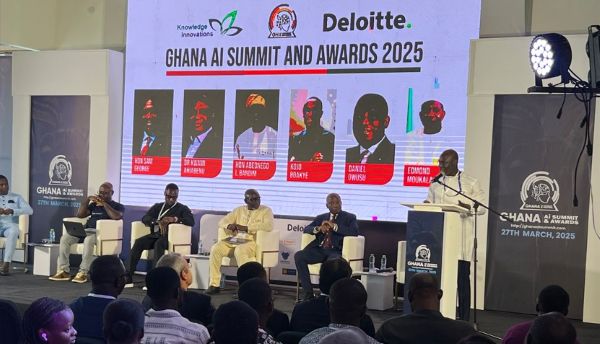
Minister for Communication, Digital Technology and Innovations, Samuel Nartey George has announced that government is developing a one-stop-shop Data Exchange Hub to power Artificial Intelligence for national development.
The Minister made the announcement in a speech read on his behalf by the CEO of the Kofi Annan ICT Centre, Dr. Collins Yeboah-Afari at the opening of the maiden Ghana AI Summit and Awards in Accra.
The summit, organized by Knowledge Innovations in collaboration with Deloitte Ghana, was under the theme “Harnessing Artificial Intelligence for Sustainable Development: Hype or Reality?” and featured an impressive line-up of speakers and panellists who are at the forefront of AI innovation and application.
Sam George stated that the John Dramani Mahama government is committed to making Ghana Africa’s leading AI hub by the end of its tenure.
He however noted that Ghana’s rich and vast data resources, which are much needed to make the country an AI hub, remain locked away in silos, limiting their potential for driving innovation and economic development.
“Large companies and institutions generate massive amount of data yet much of it remain underutilized. The problem is not lack of information but its fragmentation. Data is scattered across different systems making it difficult to integrate, analyse and extract meaningful insights from it,” he said.
According to him, without a unified approach to data management, businesses will struggle to leverage AI and advanced analytics effectively.
“To address this we are developing a Data Exchange Hub, which is a centralized platform designed to unify Ghana’s scattered data resources. This hub will serve as the backbone of country’s AI future, enabling seamless data access for application, data sciences and business users alike,” the Minister stated.
Sam George argued that integrating diverse data sets into one exchange will empower decision makers with real-time data insights, streamline governance and ensure efficient data flow across all government institutions and sectors.
This initiative, he said, will not only enhance data accessibility, but also establish a strong foundation for AI-driven innovation across industries.
“With a well structured data ecosystem, Ghana can unlock the full potential in AI, strengthening its position as a leader in AI adoption and digital transformation on the continent,” the Minister said.
Digitalizing 100 billion physical records
Sam George said, in addition to building the Data Exchange Hub, government will also digitalize all analogue records across hospitals, universities, and all public institutions, adding that over the next four years the target is to digitalize at least one hundred billion physical records.
According to him, such a massive digitalization project will ensure structured, anonymized and protected data that aligns with global data governance frameworks.
Home-grown AI Language Models
The Minister also noted that most western AI models were designed with a western perspective making them less effective in addressing Africa’s needs.
He said, to bridge this gap, “we are developing home-grown AI language models tailored to the Ghanaian and African context.”
Sam George explained that the goal is the create AI systems that understand and communicate Ghana’s local languages, ensuring that technology serves all citizens and not just those who speak English.
He said the models being designed will be voice-based to ensure that farmers and persons who can neither read English nor their native dialects can still have AI systems speak to them in their own dialects and guide them according to their specific needs.
“This is especially crucial for farmers and fisherfolk in rural areas who could really benefit from AI tool for precision farming, weather forecasting, market insights and resource management,” he said.
The Minister stated that Ghana is currently presented with a great opportunity to leverage AI to accelerate its development in the areas of finance, healthcare, agriculture, education and governance, adding that making AI inclusive helps to drive sustainable development across the length and breadth of the country on the back of digital technology.
Reviewing all Tech Sector Legislations
Sam George noted that to make none of the foregoing laudable goals can be achieved without a proper legal and regulatory framework that are in tune with the times.
In that regard, he said the National AI Strategy developed in 2022 for the next decade (2023 – 2033) with the help of GIZ, was a step in the right direction. The strategy creates the framework for AI adoption and governance in the country over the period.
But the Minister said there is the need to review that strategy as well as all industry legislations and regulations to ensure they align with national priorities.
“Since assuming office, I have directed the review of the National AI Strategy and all relevant legislations to ensure alignment with emerging AI trends. This review covers key areas such as data governance, AI ethics, privacy protection and regulatory frameworks for fintech and digital platforms,” he said.
The Minister believe the review of legislation and regulations will set the tone for smooth integration of fintech and other digital platforms to the Data Exchange Hub, the language models and other AI tools to drive inclusive and ethical AI innovation across the country.
Other speakers at the event touched mainly on the need to ensure ethical innovation and application of AI tools to ensure that users are protected and not harmed by AI.
The Board of Directors of the Islamic Corporation for the Development of the Private Sector(ICD),the private sector arm of the Islamic Development Bank(IsDB), has approved the appointment of Dr. Khalid Khalafalla as Acting Chief Executive Officer (CEO), effective 19 March 2025
Dr. Khalafalla brings extensive experience from his career within the IsDB Group. Since December 2024, he has been serving as CEO of the Islamic Corporation for the Insurance of Investment and Export Credit (ICIEC).
This was contained in an official statement issued by ICD in Jeddah,Thursday.
The Chairman of ICD’s Board of Directors, congratulated Dr. Khalafalla on his appointment and expressed the Board’s full confidence and support as he takes on this important responsibility.
Distributed by APO Group on behalf of Islamic Corporation for the Development of the Private Sector (ICD).
SOURCE
Islamic Corporation for the Development of the Private Sector (ICD)