OUAGADOUGOU, Burkina Faso, December 19, 2023/ — History of the “Solar Grandmothers” initiative
During the India-Africa Forum held in New Delhi in April 2008, an agreement was reached between the Government of India and the African Union (AU) Commission on pan-African projects for the establishment of regional Barefoot College Training Center in Africa.
This was followed by solar energy training for rural women from Burkina Faso in India with the United Nations Development Programme (UNDP) and the Global Environment Facility Small Grants Programme (GEF/SGP) financial support. In 2018, under the Ministry in charge of the Environment, the Regional Barefoot College Training Center in Burkina Faso (CRFBB) was created.
Regional Barefoot College Training Center in Burkina Faso (CRFBB)
Located in the village of Nioryida, in the South central region, about a hundred kilometer from Ouagadougou (the capital of Burkina Faso), the CRFBB is responsible for: (i) coordinating the identification of localities to benefit from its services; (ii) coordinating the selection of women to be trained at the Center, on the basis of objective criteria; (iii) providing theoretical and practical trainings for women; (iv) carrying out other types of additional trainings required to fulfil its mission; (v) taking all necessary measures to ensure a pleasant stay and high-quality trainings for the auditors; (vi) carrying out any mission entrusted by the competent authorities.
The Center also ensures the transfer of solar technology to the following countries in the sub-region: Burkina Faso, Niger, Benin, Togo, Ghana, Côte d’Ivoire and Mali.
Results of the Solar Grandmothers Project
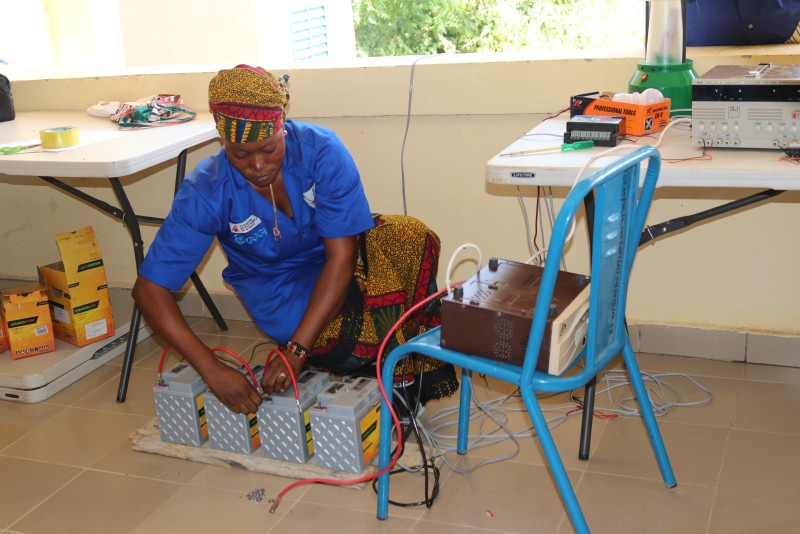
As part of the ” Solar Grandmothers project”, the Barefoot College training center in Burkina Faso, in partnership with the Global Green Growth Institute (GGGI) and the Prince Albert II of Monaco Foundation, has provided solar energy trainings for grandmothers from 07 regions of Burkina Faso (Centre, Centre-West, Centre-East, Sahel, North, Hauts-Bassins and Cascades).
The aim of the project was to empower older women to help reduce the negative environmental impact of fossil fuel use in Burkina Faso by promoting clean technologies and low-carbon energy sources. Thirty-one (31) solar grandmothers have benefited from intensive theoretical and practical trainings.
They were given kits to equip their workshops, enabling them to carry out repairs and install solar kits. After the trainings, each solar grandmother received solar kits for households in her home village. Providing households with solar kits is part of the project’s contribution to the electrification of the selected villages.
This is a “Pay As You Go (PAYG)” system managed by the local units after the beneficiary households have been selected. PAYG allows access to energy to be broken down into accessible payment schedules defined by the local committee. Setting up local management units helps to consolidate the achievements and sustainability of the project in the selected villages.
These units play a key role in managing the solar kits made available to households. Among other things, they set up a system for recovering the cost of installing the kits for households. The amounts recovered are to be used to purchase new kits for new households.
The project has made it possible to provide local expertise in solar technology in rural areas, and to increase the availability of and access to solar energy in rural areas, while improving the governance of solar energy at local level by setting up autonomous solar electrification units in the beneficiary villages.
The project’s impact can be assessed, in particular, in terms of (i) changing the status of women in their living environment, (ii) helping to raise community awareness on climate change resilience and protection of the environment, (iii) reducing inequalities and improving the living conditions of beneficiary households, (iv) reducing gender inequalities in rural areas by involving women as full players in local development, which should be accelerated by the increase in income-generating activities in the villages of Burkina Faso.
Originality and lessons learned from the project
Originality
The project’s main added value lies at several levels:
- The choice of beneficiaries who are representative of Burkina Faso’s three agricultural climatic zones: in line with the requirements of the Barefoot College, the targeting of women of a relatively advanced age as solar grandmothers improved their status from that of vulnerable people to that of people involved in local development. This is a guarantee of the stability and sustainability of what has been achieved. In addition, the representative nature of the three agricultural climatic zones is a guarantee that all of the country’s realities will be taken into account and that the approach adopted will be inclusive;
- Making the most of the expertise of former grandmothers: To train the 31 grandmothers, the Center and GGGI agreed to lean on local expertise. Three of the first grandmothers from the first class trained in India were chosen. They were able to conduct the process with professionalism. The quality of their service was unanimously recognized and praised, both by the learners and by all the stakeholders.
- Synergy with the “Burkina Faso ecovillages” initiative: this synergy contributes to reducing social inequalities and achieving sustainable energy self-sufficiency, while helping to fight climate change and preserve the environment. It also provides a better quality of life for people in the selected villages, which are being transformed into ecovillages.
- The successful experience of a Public-Private Partnership: the results achieved by the solar grandmother training project are the result of a partnership between four entities: (i) the Government of Burkina Faso, through the Ministry in charge of the Environment and the Barefoot College Training Center in Burkina Faso, entity co-initiator of the Project and in charge of hosting and supervising the training (ii) GGGI, entity co-initiator of the Project, in charge of general coordination of the Project (including fiduciary responsibility), (iii) the Prince Albert II of Monaco Foundation, international non-profit organization, (iv) Aliothsystem energy SAS (PAY-GO Solar Home System assembly unit and design and innovation start-up in the field of energy, renewable energy and energy efficiency) is the entity responsible for training and supplying the various items of equipment made available to grandmothers and households.
Lessons learned
The main lessons learned are:
- The promotion of gender equality in the field of development is a long-term undertaking, requiring greater mobilization of resources and energies, because its scope of application concerns sensitive areas such as mentalities, beliefs and behavior;
- Consolidating the evidence that if rural communities are empowered, well-organized and have their capacities properly strengthened, they are capable of caring for themselves and their development;
- Solving the problems of sustainable development (environmental, social and climate issues) that the project aims to address is a complex and costly undertaking.
- Energy, particularly renewable energy, remains essential to local development and is a real need to be met, with a view to improving people’s living conditions.
Distributed by APO Group on behalf of Global Green Growth Institute (GGGI).
SOURCE
Global Green Growth Institute (GGGI)