







Reports Bob Van Voris in The case, US v. Glencore, 22-cr-00297, US District Court, Southern District of New York (Manhattan).
Glencore Plc was ordered by a federal judge in New York to pay $700 million as a criminal punishment for a global bribery scheme orchestrated by the Swiss-based commodities trading and mining giant.
US District Judge Lorna G. Schofield on Tuesday imposed the sentence, following the terms of a plea deal with prosecutors entered when Glencore pleaded guilty in May to a single count of conspiring to violate the Foreign Corrupt Practices Act. The company must pay a fine of $428.5 million and $272.2 million in criminal forfeiture.
The penalty, one of the largest in a foreign corruption case, is part of the $1.5 billion Glencore agreed to pay to resolve bribery and market-manipulation probes in the US, UK and Brazil. Glencore units agreed to plead guilty to a list of charges ranging from bribery and corruption in South America and Africa, to price manipulation in US fuel-oil markets.
Glencore was guilty of “a very serious offense,” Schofield said, though he noted the company’s efforts to cooperate with the government and to beef up compliance procedures after receiving a federal grand jury subpoena in 2018.
Prosecutors claimed Glencore paid more than $100 million in bribes to government officials in Brazil, Nigeria, the Democratic Republic of the Congo and Venezuela. They said Glencore made $315 million from the scheme.
In addition to the fine and forfeiture, Glencore will spend five years on probation, continue with improvements to its ethics and compliance programs and employ an outside monitor for three years.
Glencore conducted an internal investigation, eventually disciplining more than 20 people, a lawyer for the company said during the hearing Tuesday in Manhattan federal court. Glencore produced more than 1 million documents, many from outside the US, and hired a forensic accounting firm to look into suspect trading activity.
On Monday, Schofield ruled Glencore must pay $29.6 million to the founders of a company that provided healthcare services in 11 African countries, but was forced to shut down. Crusader Health claimed it was driven out of business after Glencore bribed a public official in the Democratic Republic of the Congo to throw out a lawsuit brought by Crusader against a Glencore subsidiary.
In September, the commodity firm was sentenced in Connecticut to pay $486 million in fines and forfeitures in a case in which Glencore admitted conspiring to manipulate oil-price benchmarks. In November, a London judge imposed a £276 million ($333 million) penalty for Glencore’s effort to bribe government officials for access to oil cargoes across Africa.
Source: (Bloomberg News)

Timipre Sylva, the Minister of State for Petroleum Resources of Nigeria, will be attending the African Energy Chamber-organized Invest in African Energy Reception in London on January 26.
The African Energy Chamber (AEC) is proud to announce that Timipre Sylva, Minister of State for Petroleum Resources of Nigeria, will lead investment-focused dialogue during the Invest in African Energy Reception set to take place in London on January 26. With the Nigerian energy market on the precipice of another transformation on the back of diversification and market-driven policy implementation, the participation of Minister Sylva is key for securing new capital for Nigeria’s rapidly growing market, while enabling new players and financiers to expand their footprint in one of Africa’s biggest oil producing countries.
Nigeria has emerged as one of the most attractive destinations for foreign investment owing largely to the signing into law of the Petroleum Industry Act in 2021. With the Act having overhauled the country’s regulation and governance, addressing key growth inhibitors by prioritizing transparency, procedural clarity and attractive fiscal terms for regional and international players, the Nigerian energy market is more enabling for business than ever, and the Minister will showcase opportunities in the sector during the Invest in African Energy Reception in London.
The Act itself has already unlocked tangible benefits, with the country positioning itself as the biggest oil producer in Africa in 2023, despite a year of production declines owing to challenges associated with oil theft and reduced exploration. With the state-owned company, the Nigerian National Petroleum Corporation identifying and shutting down an illegal pipeline responsible for the loss of up to 600,000 barrels per day (bpd) of crude oil, production has rapidly increased to approximately 1.2 million bpd in December 2022, setting the country up for an exciting year in 2023. The country is more ambitious than ever when it comes to expanding the oil and gas market even further, with the government incentivizing E&P activity in a bid to boost production levels further. As such, opportunities for upstream players have opened up and Minister Sylva will be making a strong case for hydrocarbon exploration during the reception in London.
Opportunities in the oil industry, over 200 trillion cubic feet (tcf) of proven natural gas reserves – and opportunities to increase this figure to 600 tcf with advancements in exploration – have positioned the country as the destination of choice for financiers and project developers from across the natural gas landscape. At a time when global markets are urgently seeking alternative gas supplies in light of ongoing supply constraints, Nigerian gas has emerged as a top solution, and investors are encouraged to capitalize on the opportunities present across this rapidly growing market.
However, Nigeria’s oil and gas market opportunities transcend exports, with the country well-positioned to feed into regional supply chains. Having signed a deal with Equatorial Guinea that would see Nigerian gas being processed at the country’s Punta Europa facilities while making steady progress to complete the Trans-Saharan Gas Pipeline and breaking ground of new project developments, Nigeria is opening new opportunities for electrification and industrialization in Africa on the back of intra-African gas trade, made possible through initiatives such as the African Continental Free Trade Agreement and the progressing Central African Pipeline System.
“Through his participation at the Invest in African Energy Reception in London – taking place in partnership with the African Export-Import Bank and Rystad Energy – Minister Sylva has made clear his commitment to securing new capital for a suite of large-scale projects across the entire energy value chain in Nigeria. During the event, the Minister will be driving market-focused dialogue on why investing in Nigeria is so critical, both for the African economy and for the global energy market at large. The London event provides financiers and energy players with the unique opportunity to directly engage and connect with a leading government representative from the biggest oil producer in Africa, and the AEC is encouraging all of those interested in expanding their footprint in Africa to join us at this high-level event,” states NJ Ayuk, Executive Chairman of the AEC.
Published: January 18, 2023 5.08pm SAST-Credit(The Conversation)
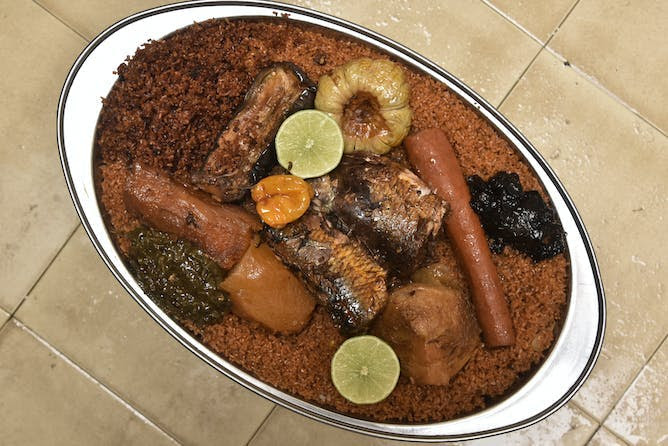
The authorship – and therefore origins – of jollof rice (called ceebu jën in Senegal according to the Wolof spelling) is the subject of a spicy debate between West African nations. In particular, Senegalese, Nigerians and Ghanaians claim ownership. And each believes their recipe surpasses all others.
In a bid to settle the issue we explored the subject in our book. In it we point out the “Senegality” of this dish. The word jollof refers to an ancient kingdom that was a part of Senegal between the 12th and the 13th centuries.
More broadly, we found that the origin of the dish is linked to a particular period in history – the entrenchment of colonial rule in West Africa. Between 1860 and 1940 the French colonisers replaced existing food crops with broken rice imported from Indochina.
In time, broken rice came to be much more prized by the Senegalese than whole rice grain.
About us
Our mission is to share knowledge and inform decisions.
This was followed by what we call le ceebu jën, un patrimoine bien sénégalais – the genius of the natives, especially the Saint-Louisians who set about creating something completely new. Ceebu jën consists of rice and fish, accompanied by vegetables and sometimes tomatoes.
As it happens in history, when an art reaches a certain fame or notoriety, its paternity becomes an object of controversy. This is what has indeed happened with jollof rice.
Colonial legacy
The first act of the settlers was to make all those disconnected from agricultural activities dependent on rice. This included the men and women who had come to try to make their fortune in the markets of Saint-Louis, one of the gateways to the West and, for a good period, the capital of French West Africa.
If we add teachers, various agents of the administration and the military, we can better understand the pernicious process of rice promotion.
Overflowing in urban centres, rice was consumed in practically all of the colony of Senegal.
The success of the rice promotion strategy resulted in the entrenchment of an economy that became increasingly dependent on crops preferred by the colonisers. To this day efforts continue to be made to grow rice in Casamance and the Saint-Louis region.
At the same time, the exploitation of the market garden areas of Niayes and Gandiol contributed to meeting the population’s need for vegetables.
Another intriguing part of the history of the dish is the myth that’s developed over centuries around the role of a Senegalese cook called Penda Mbaye who is regularly attached to the name of rice with fish.
Although no one disputes the connection between the dish and Penda Mbaye, serious information on her identity, on the place and time she lived and on the conditions in which the dish was created is cruelly lacking. This is why we have stated in our book that she left history very quickly to take her place in legend.
Why the passion?
To understand the importance of ceebu jën in the diet and imagination of the Senegalese, it would be wise to point out that its attractiveness can’t be reduced to its nutritional value or its intrinsic delicacy.
This culinary art is closely linked to a know-how and a way of life. Thus, the consumption of the dish is strongly linked to the ceremonial – the aesthetics of the presentation and the service.
A woman serving ceebu jën. Cellou/AFP via Getty Images.
The women of Saint Louis, a port city in the northern part of Senegal, are singularly credited with remarkable know-how in this area. Their finesse and elegance is expressed in the way they dress, their speech and their gestures. All are put to good use so that the meal is a moment when they give pleasure by being pleased themselves.
Stamp of approval
At the end of 2021 Unesco included the Senegalese version of jollof rice – ceebu jën – on the intangible heritage of humanity list. This certification was recognition of the know-how of the Senegalese of an integral part of an intangible heritage.
The labelling should also have a positive impact on the economy, particularly tourism, agriculture, fishing and catering. Or, as some would describe it, gastro-diplomacy.
But to make the most of all these advantages, Senegal must pay more attention to its fishery resources and, above all, settle the recurrent question of self-sufficiency in rice production for good, in order to put an end to the scandalous perversion of feeding on what is not produced.
Senegal, whose reputation is based more on its cultural influence and diplomacy, has every interest in capitalising on this trend. Thus, in addition to rice with fish, it will have to promote its broader gastronomic heritage to make it an additional asset for the role it intends to play in the concert of nations.
In this spirit, Senegal’s Food Technology Institute would be given a new lease of life. This public establishment, created in 1963, was assigned the mission of research and development in food and nutrition.
In its efforts to enhance the rich Senegalese heritage, the institute could set itself the objective of promoting all the remarkable Senegalese consumables based on millet, cowpea, bissap, ditax and (monkey bread) bouye. And to take up this challenge Senegal would be well advised to make use of all the proven expertise of researchers as well as economic players.
This article was written with the contribution of Alpha Amadou Sy, co-author of the book Ceebu jën, un patrimoine bien Sénégalais.